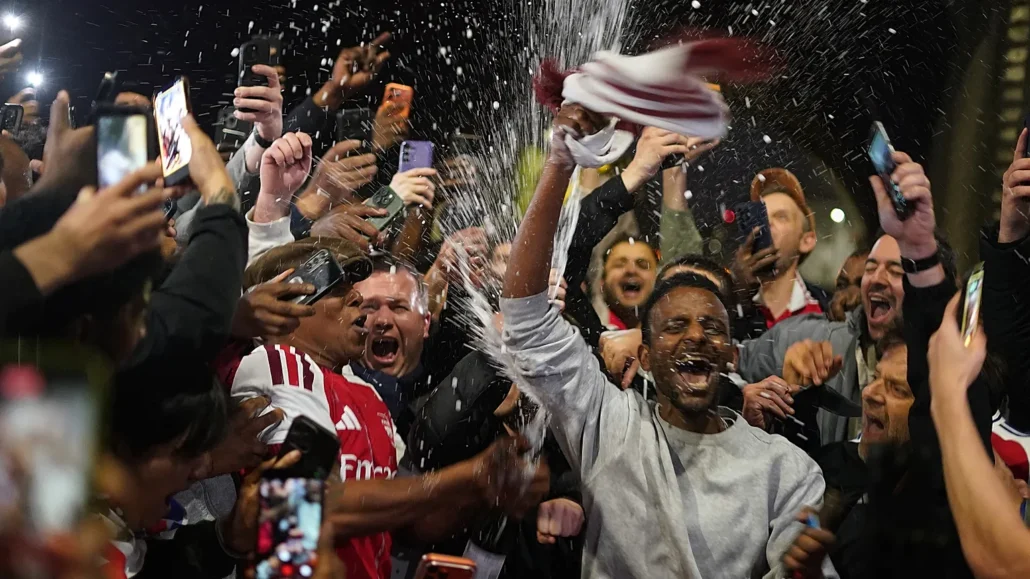
FILE PHOTO: Thousands of Arsenal F.C. fans gathered outside Emirates Stadium in London to celebrate the club’s first Premier League title in 22 years. PICTURE: Euro News
 0
0  0
0 A story of Arsenal, of grief, and of a soul that refused to be broken, writes Sibusiso Mtungwa
There is a particular kind of love that is born in loss. Not the ordinary love of convenience or comfort, but the love that crawls toward you in your darkest hour and says, here, hold onto me. That is the love I found in Arsenal Football Club. And I did not choose it as much as it chose me — right on the edge of the deepest grief a child can know.
I was fresh out of primary school in 2002, stepping into a world that felt bigger and more frightening than anything I had prepared for. I was a new supporter, eyes wide and full of wonder, watching a team in red and white play football the way artists paint — with intention, with drama, with a swagger that felt almost reckless. Thierry Henry glided across the grass as though gravity was merely a suggestion. Patrick Vieira walked into every contest as though defeat had never been personally introduced to him. Arsenal were not just winning. They were announcing something. And in 2003–2004, they went an entire league season unbeaten. The Invincibles. I had arrived at the right cathedral at the right time.
But life, as it does, chose that very season of glory to deliver its cruelest lessons.
In 2004, I lost my mother. In 2005, I lost my father. Back to back. The two people who were supposed to be my sky and my ground, gone. I was young. I was alone in a way that has no precise vocabulary. Grief at that age does not arrive politely — it does not knock. It breaks the door down and rearranges everything inside you until you can barely recognise the rooms of your own life. The world kept moving, indifferent to my stillness, and I had to find something to hold onto.
I held onto Arsenal.
And Arsenal, in their own extraordinary way, held back.
What people who have never truly followed a football club cannot understand is that a team becomes more than entertainment. It becomes language. It becomes the vocabulary you use to describe hope when you have run out of your own words for it. Every Saturday, every Tuesday, every nail-biting Sunday, Arsenal gave me a reason to feel something other than the hollow ache that had settled in my chest. Their prowess was beautiful — envied by clubs across the world — and for a boy carrying grief in his bones, beauty felt like mercy.
The club’s very identity spoke to me. Even after the Invincibles, even after Thierry left, even as the trophies dried up and the Emirates was built on ambition and optimism and sometimes not much else, Arsenal kept showing up. They played with style when they had no business being stylish. They attracted believers. And in being believed-in by them, I learned, slowly and imperfectly, to believe in myself.
But the world outside the football is rarely so faithful.
I have lived my life being doubted — not by strangers, but by the very family that was supposed to look up and say we see you. Instead, they looked sideways. They whispered. They measured me in a currency I did not recognise and found me short. And just as Arsenal endured years of being called perennial nearly-men, of Wenger’s long shadow, of the cruel tag of 62 years without a league title becoming 70, becoming 22 more — I too became someone people felt comfortable dismissing.
The worst thing about being doubted by those close to you is not that it makes you angry. The worst thing is what it does quietly, in the hours you are alone: it makes you doubt yourself. The voice from outside becomes the voice from inside, and suddenly you are fighting a war on two fronts — the one the world wages against you and the one you wage against yourself in the mirror.
So I did what any person with a surviving instinct does. I distanced myself. I chose the silence of solitude over the noise of being diminished. Like Arsenal retreating to rebuild, to regroup, to bring in Arteta and a new philosophy, a new belief system — I found my own. I found my work. I found my purpose. I found the version of myself that did not need validation to keep moving.
And then, quietly, the world outside the family began to notice.
Recognition came. Elevation came. The kind of acknowledgement that cannot be manufactured or inherited — the kind that is earned. And this should have been enough for the doubters to stand down. But that is not how envy works. That is not how insecurity dressed as family works.
When they saw that I was rising, they did not celebrate. They mobilised. The rumours came. The vile insinuations. The coordinated cruelty that only people who know your name and your history can deploy with such surgical precision. They had spent years doubting me in the dark, and now that I stood in the light, they moved to pull me back into the shadow — not because I had done anything wrong, but because my success had become an inconvenience to the story they had told themselves about me.
This, too, I have seen before. In the stands of Emirates Stadium. In the headlines that mocked Arsenal’s ambitions. In the pundits who laughed when we challenged, who shifted goalposts every time we came close. The world loves to doubt. And the world loves even more to twist the knife when the doubt refuses to disappear.
But here we are. May 2026.
Arsenal Football Club sit at the summit of the Premier League with 82 points, four clear of Manchester City, one match left to play — a trip to Crystal Palace on 24 May. The mathematics has already spoken. The trophy belongs to Highbury’s children, to the Emirates faithful, to every soul who kept the faith through the lean and the painful and the nearly years. Twenty-two years since the last title. Twenty-two years of carrying that hunger, that reputation, that wound of what-could-have-been.
Twenty-two years of people saying: Arsenal? They’re not that team anymore.
And yet. And yet.
Mikel Arteta looked at a team the world had given up on and saw not a project but a promise. He built not just a squad but a character — young, fearless, hungry. Bukayo Saka, born after the Invincibles, growing into the kind of player that would have made even Henry nod with respect. Martin Ødegaard threading vision through every attack like a man who has read the game from the future. William Saliba standing at the back with the composure of someone twice his age, making defending look like a form of art. Then came Declan Rice — the absolute engine, the glue that held the team together. Gabriel Magalhães grew into the most feared monster at the back, and his partnership with Saliba became the hallmark of our defensive line.
They have won 25 games. They have bled in the defeats — five of them — and bounced back every single time. They drew on Monday against Burnley, a nervy 1-0 in the rain, and it did not matter. The fortress holds. The table tells the truth that doubters refused to speak.
The title is coming home to North London. After 22 years, the Gunners are Champions of England.
And I am sitting somewhere in the world, a person who lost both parents before they were old enough to have learned how to grieve properly, who held onto a football club the way a castaway holds onto wreckage, who was doubted and diminished and targeted and survived — and I am weeping.
Not from sadness. From the overwhelming, chest-cracking recognition that perseverance is not a straight line. That belief is not always loud. Those who doubted you are rarely the ones present when the trophy is lifted. That sometimes the universe is writing a story about you, and the plot requires you to endure the second act before you arrive at the third.
I became an Arsenal fan in 2002. I lost my mother in 2004 and my father in 2005. I watched the Invincibles as a child and spent my adult years watching a club rebuild itself from within, refusing outside mockery, refusing to abandon their way of playing, refusing to become small.
I have done the same.
And now, as the red and white ribbons are tied to the Premier League trophy and Arteta lifts it to a North London sky that has waited 22 years for this moment — I feel my parents there. I feel every year of silence and doubt and self-exile and resilience compressed into one long, beautiful exhale.
We were never nothing. We were always this.
We were just waiting for the world to catch up.
For every Gooner who kept the faith. For every soul who survived the doubt. The long wait is over. Arsenal. Champions. At last.
* Sibusiso Mtungwa is the Managing Director of Public Eye Media, a strategic PR and communications agency.
* * The views expressed do not necessarily reflect the views of The Republic Mail.


About Author