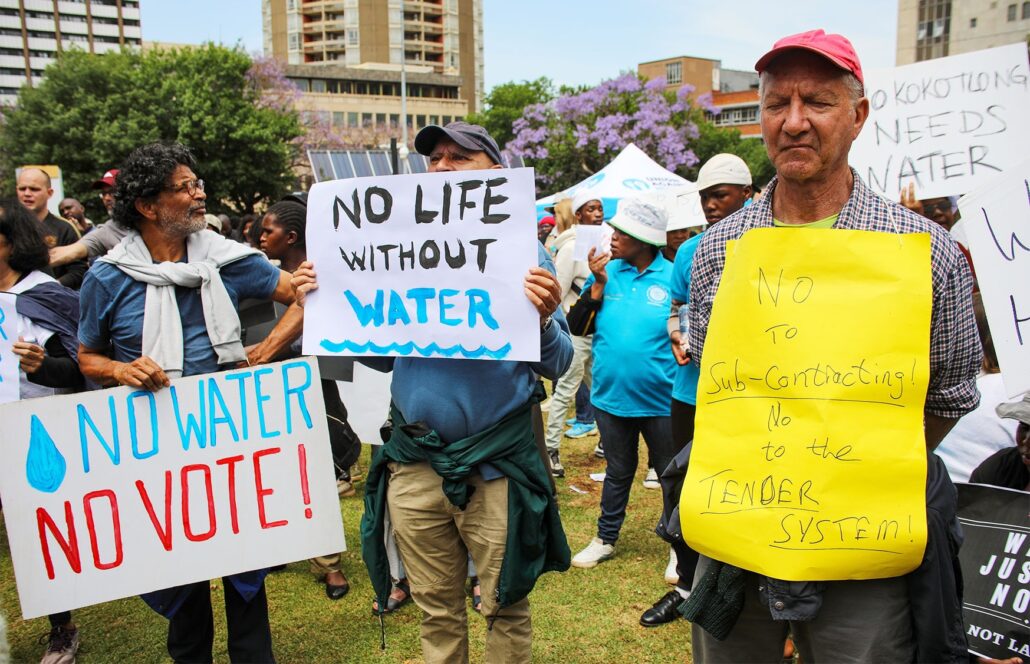
FILE PHOTO: Residents hold placards during a protest in a Johannesburg suburb against a lack of water. PICTURE: Wikus De Wet/AFP/Getty Images
 0
0  0
0 Residents deserve accurate information, realistic timelines, and open channels for reporting faults and receiving feedback, writes Sibusiso Mtungwa
Gauteng’s deepening water crisis is no longer a looming threat — it is a daily reality for millions of residents. Intermittent supply, dry taps, collapsing infrastructure, and rising public frustration point to a governance failure that can no longer be masked by technical jargon, shifting blame, or defensive political rhetoric.
Water is not a luxury. It is a constitutional right and a basic necessity for health, dignity, economic activity, and social stability. Yet across the province, communities are forced to endure prolonged outages, inconsistent supply schedules, and vague explanations, while authorities respond with excuses rather than accountability.
The current crisis did not emerge overnight. Years of underinvestment in infrastructure maintenance, poor planning, slow project execution, weak consequence management, and fragmented coordination between municipalities, provincial departments, and national water authorities have all contributed to the present state of emergency. Ageing pipelines leak millions of litres daily, while delayed upgrades and stalled projects worsen supply constraints.
Instead of addressing these structural failures with urgency and transparency, public communication has increasingly taken a defensive posture. Blame is passed between institutions, technical language replaces accountability, and residents are left in the dark about clear timelines, practical solutions, and measurable progress. This erodes public trust and deepens frustration, especially among vulnerable communities that suffer the most from prolonged water interruptions.
True leadership in times of crisis requires honesty, responsibility, and decisive action. Institutions must acknowledge shortcomings, present clear recovery plans, and implement strict performance monitoring. Emergency water interventions must be paired with long-term infrastructure investment, skilled technical management, and rigorous anti-corruption controls.
Equally important is transparent public engagement. Residents deserve accurate information, realistic timelines, and open channels for reporting faults and receiving feedback. Trust can only be rebuilt when institutions treat citizens as partners rather than passive recipients of poorly explained decisions.
Gauteng is the economic engine of South Africa and the African continent. Its water security directly impacts industrial output, business confidence, employment, healthcare services, and food supply chains. Failure to stabilise the province’s water system risks wider economic and social consequences.
This crisis must become a turning point. Defensive politics must give way to institutional accountability. The focus should shift from protecting reputations to protecting citizens. Only then can sustainable water security be restored and public confidence rebuilt.
Because when the taps run dry, excuses cannot quench the thirst of a nation.
* Sibusiso Mtungwa is the Managing Director of Public Eye Media, a strategic PR and communications agency.
** The views expressed do not necessarily reflect the views of The Republic Mail.


About Author